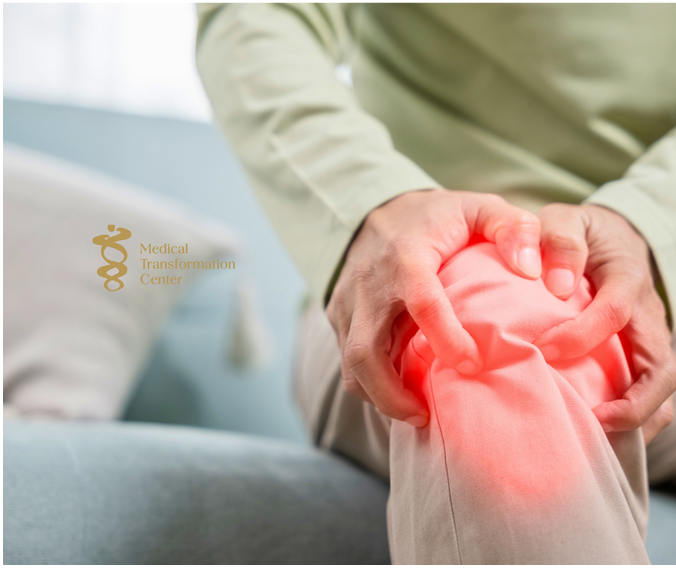

Quick answer: Many men treat pain as something to endure rather than investigate, often masking symptoms instead of asking why they're happening. Dr. Paige at Medical Transformation Center explains that pain is rarely an isolated problem — it's usually connected to old injuries, inflammation, and poor cellular function. Regenerative medicine offers a way to address the root cause instead of just numbing the discomfort.
There's a particular kind of pride men carry around pain. A bad shoulder from years of lifting. A knee that clicks every time you take the stairs. A back that "just does that now." Somewhere along the way, pain became a badge of honor — proof that you worked hard, played hard, and didn't complain about it.
This is Part 3 of our Men's Health series with Dr. Paige at Medical Transformation Center. Part 1 tackled testosterone. Part 2 took on the "dad bod." This time, we're talking about pain — specifically, why so many men misunderstand it, and what that misunderstanding costs them.
According to Dr. Paige, the biggest mistake isn't ignoring pain altogether. It's normalizing it. And normalizing pain means missing the chance to actually fix what's causing it.
Why do men say "I've learned to live with it" instead of getting help?
Ask a man about his chronic shoulder pain and there's a good chance you'll hear some version of "I've just learned to live with it." It sounds like resilience. It's actually resignation.
Dr. Paige sees this pattern constantly. Men wait years before addressing pain, often until it starts interfering with something they can't ignore — sleep, work, or the ability to keep up with their kids. By that point, what could have been a straightforward fix has often become a more complicated one.
"Learning to live with it" isn't a strategy. It's a delay tactic. And delay tactics don't heal anything — they just give the underlying problem more time to compound.
Why do most pain treatments miss the real question?
Here's the deeper issue: even when men do seek treatment, most conventional approaches focus on a single question — how do we make this stop hurting? That's an understandable goal, but it's the wrong starting point.
The better question, according to Dr. Paige, is: why does it hurt in the first place?
Anti-inflammatories, cortisone shots, and painkillers can quiet symptoms. None of them answer why the pain showed up. Without that answer, the pain typically returns, sometimes worse, because the actual source was never addressed.
Can pain in one area really be connected to something else in the body?
Pain rarely exists in isolation. A knee that hurts might not be a knee problem at all — it could stem from decades-old compensation patterns following an old ankle injury. A stiff neck might trace back to shoulder weakness. Chronic inflammation somewhere in the body can amplify pain signals everywhere else.
Dr. Paige points to three common threads behind chronic male pain:
- Old injuries that never fully healed. The body compensates around damaged tissue, creating new stress points elsewhere.
- Chronic, low-grade inflammation. Often driven by diet, stress, or poor sleep, this keeps tissues in a constant state of irritation.
- Poor muscle activation. When certain muscle groups stop firing correctly, other structures — joints, tendons, ligaments — absorb the load they weren't built to carry.
Treating the site of pain without addressing these underlying factors is like repainting a wall that keeps cracking. It looks fine for a while. The crack always comes back.
What is Cellular Medicine and why does it matter for pain?
Cellular Medicine is the framework Dr. Paige uses to look at pain more broadly. Instead of viewing the body as a collection of separate parts, Cellular Medicine examines how cells throughout the body are functioning — and, more importantly, how well they're able to repair themselves.
Pain, inflammation, and slow healing all trace back to cellular health. When cells have what they need to function and regenerate, tissues recover faster and more completely. When they don't, injuries linger, inflammation persists, and pain becomes chronic.
This shift in perspective — from "which joint hurts" to "how well are my cells healing" — is what separates symptom management from real recovery.
How does regenerative medicine help the body heal instead of just masking pain?
Regenerative medicine is built around a simple but powerful idea: help the body heal itself, rather than override its signals with medication. Instead of blocking pain, these approaches aim to repair the tissue that's causing it.
Dr. Paige and the team at Medical Transformation Center use several regenerative approaches, often in combination, depending on what a patient's body needs:
- PRP (Platelet-Rich Plasma): Concentrated platelets from a patient's own blood, used to accelerate tissue repair.
- Stem cells and exosomes: Cellular signaling tools that support regeneration at the site of injury.
- Peptide therapy: Targeted compounds that can support tissue repair and reduce inflammation.
- Acoustic wave therapy: Sound waves used to stimulate blood flow and healing in damaged tissue.
- HIFEM® (High-Intensity Focused Electromagnetic) technology: Used to help restore proper muscle activation.
- Laser and radiofrequency therapies: Non-invasive tools that support tissue repair and reduce inflammation at the cellular level.
None of these tools work in isolation. According to Dr. Paige, the goal is to build a personalized plan that matches the specific cause of a patient's pain, not to apply the same protocol to every case that walks through the door.
What role do nutrition, sleep, and movement play in healing pain?
Regenerative treatments work best when the body has the right foundation to support healing. That means the fundamentals still matter — arguably more than ever.
Dr. Paige emphasizes three foundational pillars for men working to resolve chronic pain:
- Nutrition and IV therapy. The body needs the right nutrients to repair tissue. IV therapy can help correct deficiencies faster than diet alone in some cases.
- Sleep. Most tissue repair happens during deep sleep. Poor sleep quality directly slows healing, regardless of what treatments are applied.
- Movement and exercise. The right kind of movement — not necessarily more of it — helps retrain muscle activation patterns and prevent compensation injuries from recurring.
Skip these fundamentals, and even the most advanced regenerative treatment has less to work with.
How can men change their relationship with pain?
Changing how men think about pain starts with changing the question they ask. "How do I make this stop?" leads to short-term fixes. "How do I help my body heal?" leads somewhere much more useful.
That shift doesn't require men to abandon toughness or resilience. It just redirects it. Toughing it out isn't the problem — toughing it out without ever asking why is.
Ready to stop just living with pain?
Pain is information, not a badge of honor. It's the body's way of flagging something that needs attention, and ignoring that signal doesn't make the underlying issue disappear.
If you're a man who has spent years managing pain instead of resolving it, this is a good time to ask a different question. Dr. Paige and the team at Medical Transformation Center in Louisville, KY, specialize in getting to the root cause of pain through Cellular Medicine and regenerative approaches tailored to each patient's story.
Visit medicaltransformationcenter.com to request an appointment and start asking the better question: how do I help my body heal?
Frequently Asked Questions
Is regenerative medicine painful or invasive?
Most regenerative treatments, such as PRP, peptide therapy, and acoustic wave therapy, are minimally invasive and performed in-office. Discomfort is typically mild and temporary compared to surgical alternatives.
How long does it take to see results from regenerative treatment for pain?
Timelines vary depending on the treatment and the underlying cause of pain, but many patients notice improvement within a few weeks, with continued healing over several months as tissue regenerates.
Is regenerative medicine a replacement for physical therapy or exercise?
No. Dr. Paige recommends pairing regenerative treatments with proper movement, nutrition, and sleep to give the body the best foundation for healing.
Who is a good candidate for regenerative pain treatment?
Men dealing with chronic pain from old injuries, joint issues, or inflammation who haven't found lasting relief through medication or rest are often good candidates. A full evaluation, including lab work and diagnostics, helps determine the right approach.
What makes Medical Transformation Center's approach to pain different?
Medical Transformation Center uses a Cellular Medicine framework, looking at how the whole body's cells are functioning rather than treating pain as an isolated, localized issue.